
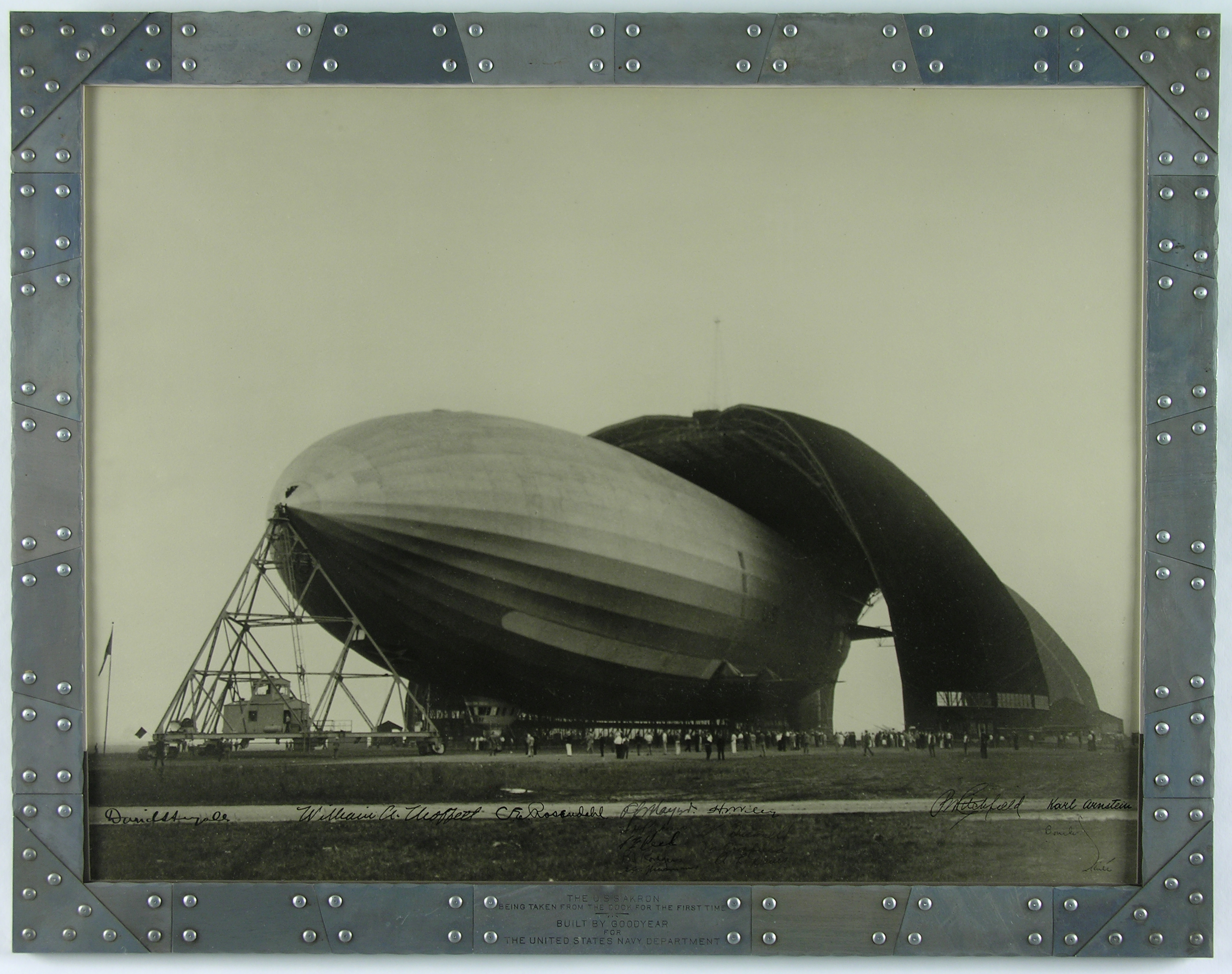
Margaret Bourke-White
(The Bronx, New York, 1904 - 1971, Stamford, Connecticut)
United States Airship "Akron"
1931
Gelatin silver print
17 1/2 x 23 1/8 in. (44.5 x 58.7 cm)
Collection of the Akron Art Museum
Bequest of Barbara Jacobs
2006.3
© Estate of Margaret Bourke-White / Licensed by VAGA at Artists Rights Society (ARS), New York, NY
More Information
Margaret Bourke-White (1906-1971), whose dramatic photographs adorned the covers and pages of Life and Fortune magazines over many years, was one of the country's foremost photojournalists during the Depression and World War II. In 1931, under contract with Goodyear, she photographed the Airship Akron as it first emerged from the Goodyear Airdock. Bourke-White's prints of this striking image were signed by the photographer (and sometimes other dignitaries) and placed by Goodyear in frames made of Duralumin, the same material used for the girders in the airship. Goodyear used the signed, framed prints as one of its prizes in a national sales contest, called the "Zeppelin Race," among its tire dealers across the country in mid-1931, during the peak of the Depression. The Goodyear Triangle, a company internal publication, said in the September 22, 1931, edition that "this historic and non-replaceable picture will be more appreciated by your dealers than anything Goodyear has ever given them before as a prize." The following month, the company announced in The Goodyear Triangle that there had been so many employee inquiries about Bourke-White's Airship Akron photo that it had been decided to sell all remaining framed prints on a first-come, first-served basis to any interested Goodyear employee, for "the price of $4.25 f.o.b. your Goodyear branch." The print on display here was presented to Goodyear executive Vivian Russel Jacobs and handed down in his family. How many of these framed Airship Akron prints by Margaret Bourke-White wound up in other Akron homes or at Goodyear dealerships across the country is unknown. However, in 1987, one of the signed, Duralumin prints made its way to the famed Sotheby's auction house in New York, where on May 6, 1987, it sold at auction for more than three times its estimated auction price and more than 4,000 times its original Goodyear sale price to employees. That high price, inspired in part by the belief that the work was a one-of-a-kind item, encouraged a number of owners to send their copies to auction. Needless to say, these later sales brought lower prices.
Keywords
NavyBlimps
American
Akron
Documentary
Black and White