About

About the Akron Art Museum

Mission

The Akron Art Museum invites all people to enrich their lives through modern and contemporary art.
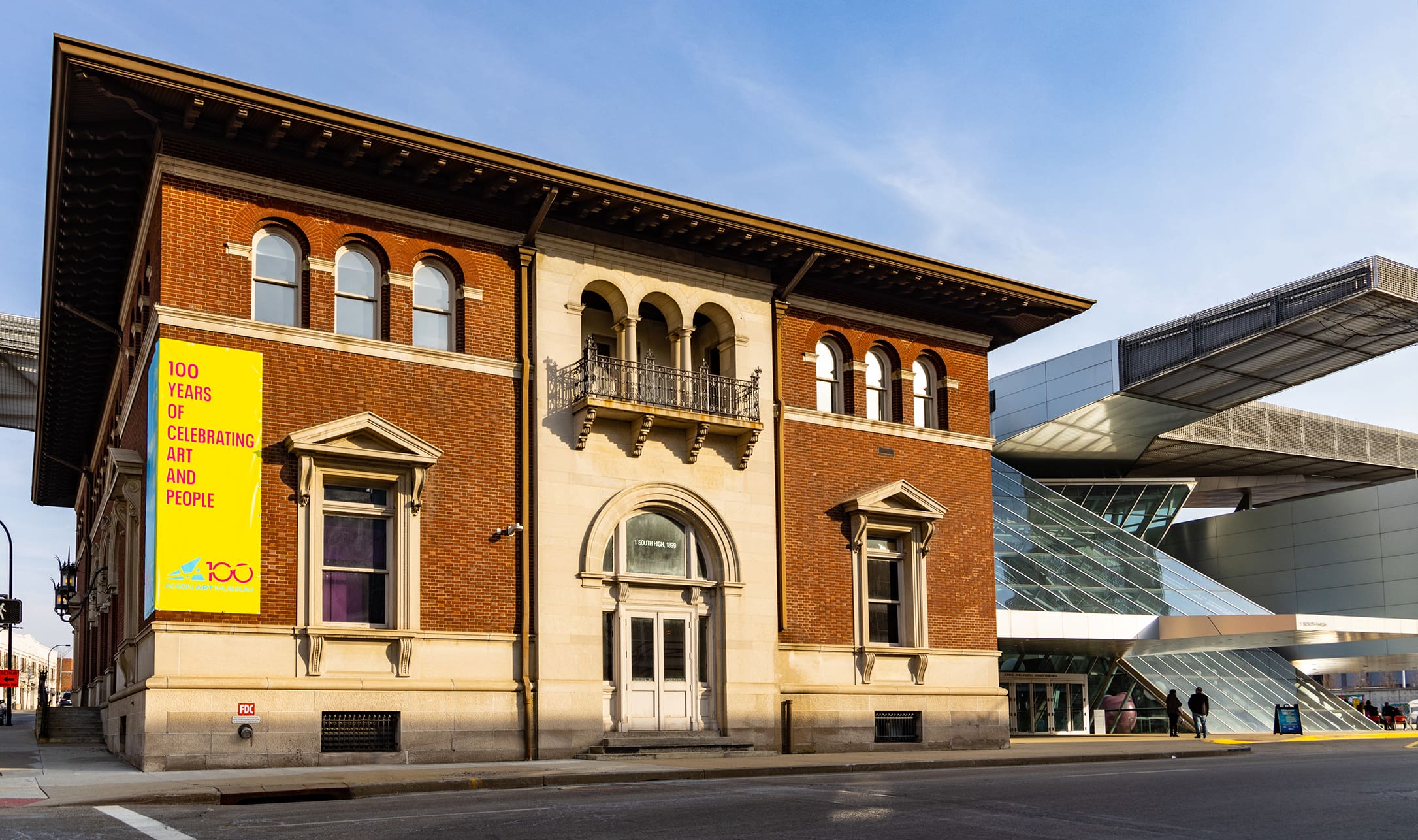
The Akron Art Museum's 1899 Building

History

When the Akron Art Museum opened as the Akron Art Institute in 1922, it owned no works of art. The organization was run entirely by volunteers in two donated rooms on the ground floor of the Akron Public Library. One of the earliest milestones came with prominent Akron collector Edwin C. Shaw. Shaw donated the first work in the Museum’s collection, Surf by Elliot Torrey. That gift foreshadowed a direction the Museum would eventually embrace modern and contemporary art.  
Like many cultural institutions, the Akron Art Institute struggled during the Great Depression. From 1931 to 1945, the organization relied solely on-board members and volunteers, with only a single paid gallery attendant. These volunteers organized exhibitions, lectures, and art classes and evolved the promotion of the space as a local art center rather than a Museum. 
The Museum moved during this period to the Commins Mansion on Fir Hill, its first permanent home. The impact was immediate: attendance rose to 21,500 visitors and membership grew to 270. But in 1942, a disastrous fire struck the Mansion. The Akron Beacon Journal described the fire as “a blaze which mounted to uncontrollable proportions fanned by a 20-mile-an-hour wind” (Alan Rosenfeld, Akron Beacon Journal, 1942). The fire destroyed the mansion and much of its contents. Losses of art were estimated at $160,000, equivalent to roughly $3 million today. 
The fire could have marked the end of the Institute. Membership had dropped to an all-time low of four by April 1944. But in phoenix-fashion, the Akron Art Institute decided to focus as an art center and focus on current art instead of the history of art. Exhibitions, lectures, and classes would become the focus instead of a collection of art. 
In 1950, the Institute found a new home in the former public library at 69 East Market Street. By this time, the mission statement had evolved to “a museum where works of art may be housed for the enjoyment and education of the people.” By this time, the Museum’s collection began to explode with turn-of-the-century paintings that would complement those from Shaw’s collection (such as Surf). The collection became so massive that the tiny curatorial staff could not expertly evaluate the art, which came from so many cultures and periods, resulting in an uneven-quality collection. 
Events have always been the heartbeat of the Museum, and the Masked Ball began to raise funds to purchase art directly. The sale of items purchased with Masked Ball contributions has been the largest amount from any single source. Whereas in 1945, the Museum owned fewer than a hundred objects, by the end of 1965, the Museum owned over two thousand works, some of which were of art historical significance. Space was becoming a problem! This led to the insertion of a new objective: “to receive and hold in trust for the benefit of the community significant objects of the highest artistic merit.” 
By the 1970s, the Museum’s exhibitions and acquisitions would focus on one goal: a concentration on twentieth-century art. This was a great period for the institution: the Institute was financially stable and had an endowment fund in place. Pop Art took over the scene, while avant-garde went out of vogue. The Museum was able to acquire Single Elvis by Andy Warhol back when he was a younger artist before his burgeoning on the scene. While the late 1970s and 1980s were a depressed period for Akron following high unemployment, a troubling economic recession, and the death of rubber, the Institute managed to thrive. 
A devoted anonymous donor donated three million dollars, which helped make possible a move across the street to 70 East Market Street, the former post office also called the 1899 Building, which is a building that makes up the modern Akron Art Museum campus. The new site offered more parking, a better gallery configuration, and a loading dock, although it did not address the need for storage space. 
The Museum’s original goal of becoming a large museum was abandoned. The Museum decided to narrow its collection focus and promote the institution as an exhibition center with small but choice holdings of modern art. This new mission meant that all art predating 1850, work from other cultures, and the education collection would be sold. The money raised from those sales would “build the nucleus of a first-rate modern collection.” These changes took years for board members and advocates to accept but in the long run made for a more successful and healthier institution. 
Another goal was to present art that was relevant to the lives of people in Akron but did not sacrifice the standard of art historical significance called for in the new mission. Beautiful, commissioned works were created in this time, like Lee Friedlander’s photographs of Rust Belt nature, and Robert Glenn Ketchum’s documentation of the Cuyahoga Valley National Park. The Museum’s notorious photograph collection began to blossom with purchases of key works from Ansel Adams and Minor White. 
The Museum needed to diversify its collection to represent the pluralism of the contemporary art scene. It gained photorealistic pieces from Chuck Close and Richard Estes, Frank Stella’s abstracts, sculptural work from Jackie Winsor and Sol LeWitt, and acquisitions from Donald Judd and Robert Morris. The Museum’s infamous Inverted Q by Claes Oldenburg was gifted at this time by Mary and Louis Myers. 
In October 1980, the importance of collecting as part of the institution’s mission was sealed by a name change. This transition to the Akron Art Museum marked the shift of the organization’s focus on collecting work. With funds from the de-accessioning of older works depleted, the Museum worked with community leaders and Museum donors to create new funds for the Museum. The Museum approached the John S. and James L. Knight Foundation, which remains a crucial partner and supporter of the Museum to this day. 
And while contemporary art continued to blossom and change, so did the Museum. In 2007, the Museum’s eighty-fifth year, the Museum more than tripled its size to open the new John S. and James L. Knight Building, which adjoins the 1899 building. The building was designed by the Viennese architectural firm Coop Himmelb(l)au. The architecture has already proven itself to be an iconic element of Akron’s architectural skyline. 
After celebrating their centennial in 2022, the Museum soon embarked on a renovation of the historic 1899 Building, which opens to the public in 2026 with more art and space for the community while honoring the Museum’s heritage. 
After surviving economic hardships to devastating fire to refining its mission, the Museum remains committed to enriching contemporary lives with contemporary and modern art. 

Values Statement

We believe in the value of art and artists.
The Museum builds, studies, and shares our outstanding modern and contemporary collection of regional, national, and international art. We celebrate and collect emerging and established artists, invest in art that honors diversity and creativity, and preserve world-class art and architecture for future generations.

We believe in the power of museums to inspire and educate.
The Museum provides access to varied experiences that educate, inspire, and engage. Visitors are invited to learn, play, and grow while connecting with themselves and others. Experiences with art and artists are designed to explore the creative process and offer insight into how artists reflect human experience and culture across time and geography.

We believe in working with and for our community.
The Museum exists to serve the community and does so by building strong relationships through collaborative partnerships, constructive dialogue, and diverse representation.

We believe in fostering a culture of respect.
The Museum respects and values our stakeholders throughout all of our interactions. Welcoming others with a sense of belonging and valuing their contributions is of utmost importance.

We believe in accountability and continuous growth.
We strive for progress by living our values honestly and transparently as well as focusing on continuous growth through experience, collaboration, and introspection.

Curatorial Vision

The Akron Art Museum features artwork produced from 1850 to today with a commitment to engage with current, pressing issues in their full complexity and nuance. That focus animates both the building of the permanent collection and the creation of special exhibitions. To achieve this vision the Akron Art Museum follows these principles: supports artists who have historically been marginalized; champions artists whose artwork expands, redefines, or rejects traditional mediums; and promotes and displays the work of regional artists. Most importantly, adhering to the curatorial vision makes good on the Museum’s promise that all visitors feel welcome and see themselves reflected in its programming.

Learning & Engagement Philosophy

The Akron Art Museum provides unique, accessible, meaningful experiences that are created by and for the communities they serve.

Statement of DEAI

The Akron Art Museum welcomes all people. We are committed to valuing diversity, fostering equity, and creating accessible and inclusive experiences with art and community where everyone can feel a sense of pride and belonging. We acknowledge that the Museum’s history has been shaped by past biases and inequities; the effects of which remain with us today. However, we believe that the arts have the power to both reckon with the past and make way for a better future. Through our actions, the Museum seeks to embrace and reflect the voices of all.

Land Acknowledgement

This is the traditional land of many diverse nations, including the Ohio Seneca and Cayuga, the Lenni Lenape (Delaware), the Miami, the Shawnee, the Wyandot (Wendat), the Odawa (Ottawa) and the Ojibwe Nations. It was these Indigenous People whose cultures, lifestyles, spiritual beliefs, and traditions shaped this land. The Akron Art Museum serves the community within this same place. Native history is American History and we acknowledge the Museum is indelibly intwined with indigenous exploitation and dispossession. The Akron Art Museum pays respect to the native forebearers of this land, honoring the roles indigenous communities have historically held and continue to hold in shaping the future of our shared home. We commit to the continuous processes of education in Native arts, relationship building with and among Indigenous Peoples, offering community space with which to share thought, dialogue and art, and concerted shifts toward sustainability and environmental stewardship initiatives.