
Mireille Delice
(Léogane, Haiti, 1965 - )
Baron Samedi
2016
Beads on Fabric
33 x 31 in. (83.8 x 78.7 cm)
Collection of the Akron Art Museum
Purchased with funds from the Rory and Dedee O'Neil Acquisition Fund
2025.13.2
More Information
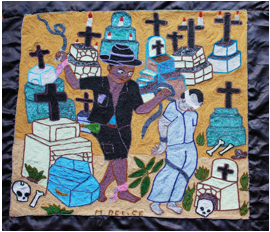
Mireille Delice’s flag portraying the Vodou spirit Baron Samedi lends an opportunity to directly confront some of the most pernicious stereotypes about the Vodou religion, namely the portrayals of “zombies” in Western media and culture. Baron Samedi is known as the patriarch of the Gede nanchon, and as the lwa of the dead. In temperament he is considered to be wise for holding knowledge of the dead and the world beyond life, but he is also known as a trickster and a drinker of rum who engages in lewd behavior. Delice’s image of Baron Samedi is typical, as he is associated with the colors black, purple, and white and is typically seen in formal attire with a black top hat and coat, and sometimes dark glasses and a walking cane. Delice’s setting of a cemetery is particularly appropriate, as in Vodou cemeteries the first man to be buried is said to become a manifestation of Baron Samedi, while the first woman to be interred becomes a manifestation of his wife, Gran Brijit, with the pair serving as guardians of the graveyard and its inhabitants. In Delice’s composition, Baron Samedi leads a man who he may be guiding to the afterlife, or who may be a zonbi separated from his soul. With the latter interpretation, it is important to note that within Vodou, a zonbi is not the flesh eating “zombie” of Hollywood. Rather, they are one whose soul and willpower have been stolen by magical means, left in a state described by Karen McCarthy Brown as “articulating a memory of the loss of control over self suffered during slavery.” Brown adds credence to this connection in noting that “The zonbi is led around on a leash, chained at night, and beaten when he does not respond quickly enough.” The icon of a leash corresponds to Delice’s image, where the pale figure’s binding might be a rope or perhaps a snake. Brown concludes that “Zonbi stories and images are about power and powerlessness, and about the distorted relationships that exist between the overly powered and those who are in various ways enslaved.” Insofar as Baron Samedi controls and limits the kind of sorcery that can produce a zonbi, and as the narrative in Delice’s image is not entirely clear—the spirit could be supplying aid, justice, or mischief—these general themes are helpful to keep in mind for the work’s interpretation.