
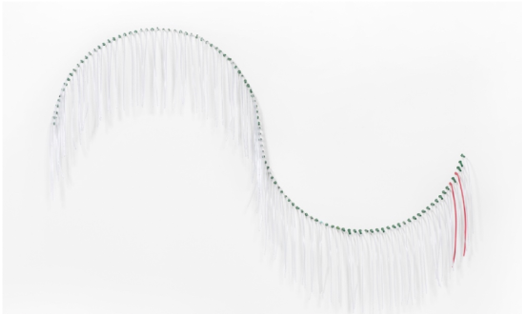
Emily Barker
(San Diego, California, 1992 - )
Singe Use Only
2017
Intermittent catheters
60 x 120 in. (152.4 x 304.8 cm)
Collection of the Akron Art Museum
Purchased with funds from the Museum Acquisition Fund
2025.12
More Information
Emily Barker has provided this artist statement on 'Single Use Only': "Single Use Only is a sculptural work consisting of the type of catheters Emily Barker prefers to use, presented in a wave form. This work was conceived a few years after the artist became paralyzed, struggling every day to use the restroom and avoid getting urinary tract infections, which would occasionally result in kidney infections and sepsis, with treatment causing further antibiotic resistance. In a month, about 120 catheters are used per paralyzed person, costing hundreds of dollars—a part of the 'Crip tax,' under which a disabled person’s survival costs four times more than average. These single-use plastic medical objects become waste clogging up landfills and harming animals. This work shows how mass production of medical objects necessary for the survival of disabled people contributes to an immense amount of waste materials while also poisoning the bodies of those who use them. The work can be installed with 120 catheters, or throughout a room with larger amounts in multiples of 120 in a continuous wave form to symbolize the current of neurological electrical impulses needed to empty one’s bladder." Barker has also clarified that the red catheters featured in 'Single Use Only' match those that medical staff have provided during Emergency Room visits, and that the quantity of red catheters included in the work is meant to signify the amount of time that the artist has spent in the ER. As with the best of Barker’s work, 'Single Use Only' places viewers in a direct confrontation with objects that may seem innocuous but quickly take on heavy and even dire significance. This balance between lighter banality and weightier intensity is indeed apt for a work conceived to draw attention to the daily realities of disability, which encompass both of these poles. With its wave pattern, 'Single Use Only' also adds a symbolic and aesthetic dimension to the objects that it encompasses. In addition to the suggestion of neurological signals, the wave also helps to indicate the specific interval of a month that Barker mentions in their statement, especially in larger installations of the work. But the wave also presents the catheters not as a utilitarian stack or a casually haphazard pile, but in an intentional arrangement that brings visual sensibility to bear. In a museum context, this aspect strengthens the innocuous or lighter side of the work—as an aesthetic arrangement, the wave pattern can coexist comfortably alongside other artworks in a gallery. This leaves visitors to discover the work’s heavier and more intense connections and meanings through gradual realization—an effective means of mediating the shock of compelling information that may be new. Less directly, the aesthetic qualities of the wave form may also reflect the aesthetic qualities of the bureaucratic and economic systems that surround medical care, with their abstruse rules and internal coherence that often impede external benefit and obscure the underlying realities of those in need of care.