
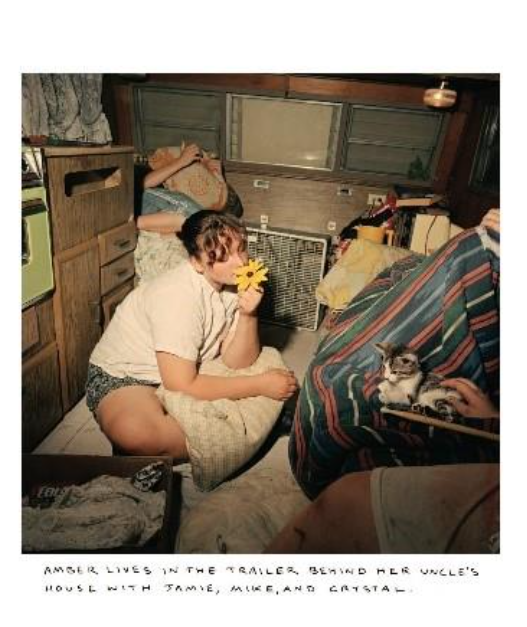
Chris Verene
(DeKalb, Illinois, 1969 - )
AMBER LIVES IN THE TRAILER BEHIND HER UNCLE'S HOUSE WITH JAMIE, MIKE, AND CRYSTAL
From the series "Family"
1998
Chromogenic print
36 x 30 in. (91.4 x 76.2 cm)
Collection of the Akron Art Museum
Gift of Fred and Laura Ruth Bidwell
2025.20.3
Copyright of Postmasters
More Information
These photographs come from Verene’s series titled “Family,” and the artist has written this statement on that broader body of work: I began to make these pictures in the late 1980s, while I was in high school. The process of photographing my family and their hometown community in rural Illinois grew throughout my adult life. Until about 1997, my pictures were known only to family, friends, and classmates. By the time I was age 29, my pictures were on display in New York museums, and my first book was due to be released. I have now been documenting the same people in Galesburg, Illinois now for thirty-five years, where three generations of my family have lived since 1900. Each person you see here has been in my life for a very long time, and my commitment to our relationship is forever, for good times and bad times, for all the future. My family accepted my plan to follow their lives with my camera. I am honored that they still encourage me to this day. It continues to be my aim to make honest pictures of my family and friends--pictures that show true stories that anyone can understand. Here, Verene explains that his intention is to “document” members of his family, a word that might suggest the sort of “documentary” photography that aspires to a cool and uninvolved objectivity. However, the remainder of the statement makes plain the direct and personal connections that the photographer has with his subjects, indicating an approach through which documentary authenticity comes not through detachment, but rather attachment that is frankly acknowledged. Reviewing Verene’s 2010 exhibition Family for the Brooklyn Rail, Cora Fisher provides an effective description of this combination of qualities: Verene has compiled a profoundly compelling body of work, centered around a locale, Galesburg, Illinois, and the intimacy of long-term relationships, that is both unsentimental and generous as it lays bare the lives of his family and friends… Verene takes a documentary approach while decidedly embracing the bias of his lens. As a member of this genealogy, he claims no freedom from subjectivity. While other photographers such as Sally Mann and Nan Goldin have accomplished similar feats of complicated intimacy, Family seems closer to chronicling emotions than mediating them. Critical in setting this tone are the handwritten captions that Verene adds to nearly all of his photographs, including each edition of the prints under consideration here. The artist insightfully describes their importance: The text is like signing your name on a letter or document. It's one's own writing, and it guarantees that one stands behind what is written. I struggle with the writing every time—it is hard to do, very permanent, and must be done on every single piece throughout my history. It is the best I can do, but often looks imperfect. It also probably keeps me outside of some curatorial worlds, it's perhaps too weird, too personal, too off-beat in a cool Chelsea world of photo—filled with the slick conceptual object-photos of Roe Ethridge, Oliver Boberg, Sarah Charlesworth, Gursky, etc. The handwritten text is a rule—I almost always do it, and I can't escape my thoughts. One key to understanding the text is that it's usually… like a family album—it tells us why a picture was taken at that exact moment, it tells what was thought to be the story's end at that moment or other key fact that was in our minds when I came to make a picture. Since Verene’s relationships are central to his photographs, it is helpful to note that the works included in this proposal feature his friend Amber, as well as his cousin Candi and her children Cody and Caity. Candi’s husband Craig is also mentioned in a caption (the two divorced not long after the 2005 date of the photograph). Four of the included photographs follow Amber’s life from adolescence into adulthood, motherhood, and poverty across a period from 1998 through 2007. Amber had each of her children by a different man, though her primary partner was a woman. In the New York Times, Holland Cotter noted Amber’s perseverance, which he characterized as common to Verene’s subjects: Amber’s life seems even rougher. In 2006 we find her, apparently homeless, living with her children in the back of a car, then a year later in a breathtakingly dumpy abandoned restaurant. The circumstances suggest lives in a state of turmoil, but the images don’t bear this out. In every shot, Amber looks rock-solid, impassively attuned to her children, soldiering on. Further background on Galesburg may also be helpful—the town’s Maytag appliance manufacturing plant closed in 2004 was relocated to Reynosa, Mexico. President Barack Obama subsequently mentioned Galesburg in a Democratic National Convention speech and a State of the Union Address as an example of “rural communities that have been hit especially hard” by the 2008 financial crisis.