
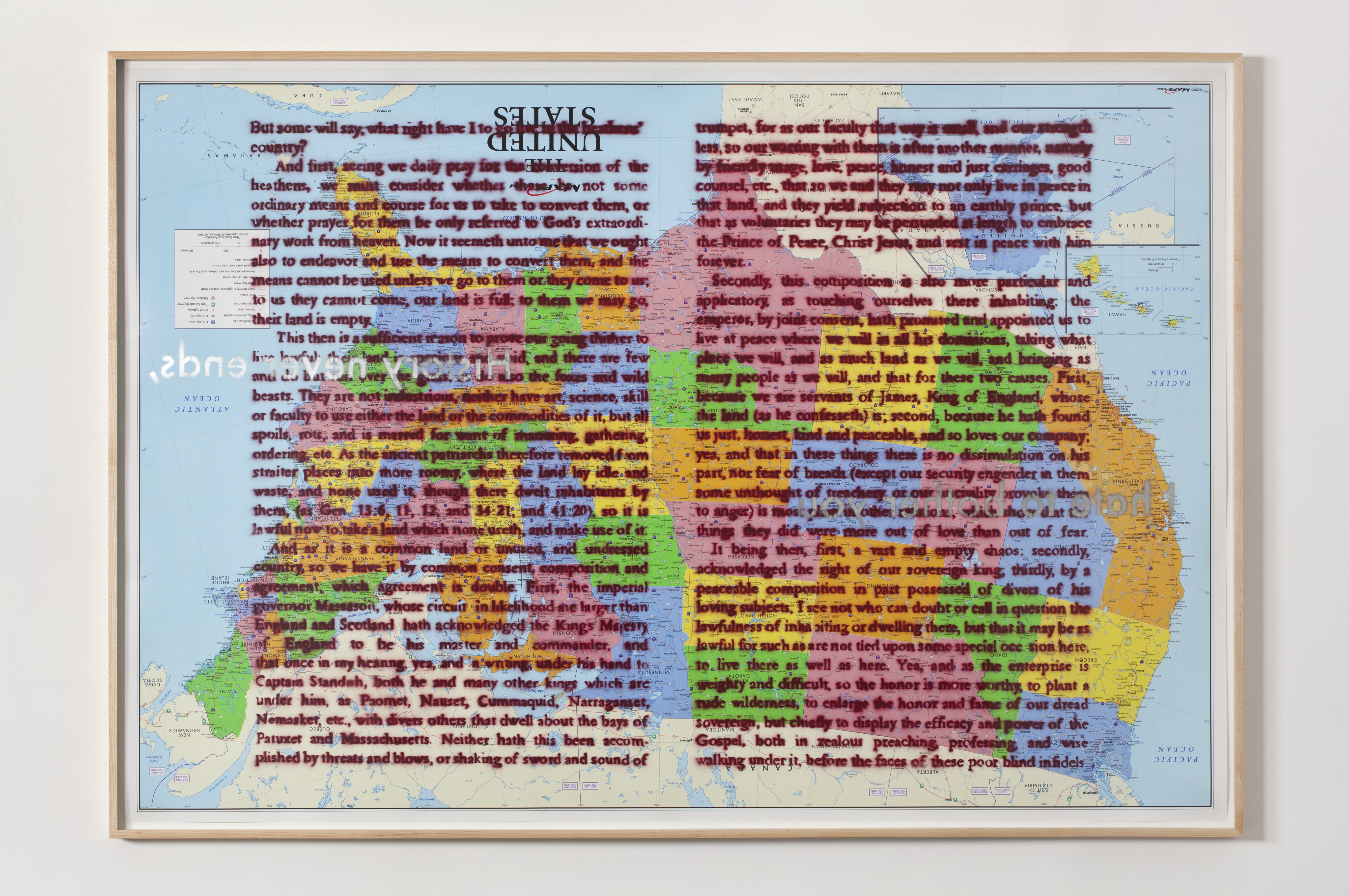
Sam Durant
(Seattle, Washington, 1961 - )
United States History Never Ends
2011
Spray enamel on Map
45 3/4 x 66 in. (116.3 x 167.6 cm)
Collection of the Akron Art Museum
2025.26
Copyright of the artist and Paula Cooper Gallery
More Information
'United States History Never Ends' debuted as part of Sam Durant’s 2011 solo exhibition at Blum & Poe Gallery in Los Angeles titled Laissez faire et laissez passer, le monde va de lui même. This title borrows the entire quotation from which the shortened phrase “laissez faire”—which has become widely used to signify free market or neoliberal economic policy—was derived. The longer slogan came from Vincent de Gourney, a French commerce secretary, who popularized it in the mid-1700s. It translates in full as “Let do and let pass, the world goes on by itself.” Durant’s exhibition reflected on the wider mercantilism and colonialism bolstered by laissez faire economic philosophy through an investigation of maps and the more active idea of mapping who makes the map, and who gets mapped. The artist’s work drew attention to the ways in which the art of cartography functions as a political art, showing that though they are usually presented as representations of objective or scientific truth, maps serve as tools to portray the world as the maker would like it to be viewed. The exhibition was divided into three related groups of works: a series of globes, a large aluminum floor map, and a series of altered maps. For the first and largest gallery, Durant worked with the Illinois-based globe-making firm Replogle to produce six unique large-scale globes, which were suspended from the ceiling and floor, allowing them to hover freely in space. The globes depict a range of unusual data, either directly or obliquely referring to economic issues such as states or nations with the highest rate of money laundering or top gold mining and pork producing nations. The exhibition’s culmination came with a twenty-four-foot-long sheet metal floor map, cut into the shape of a Goode homolosine projection (colloquially referred to as the "orange-peel" map) with the continents and countries colorfully stenciled on. The map was a mirror image, creating the effect of standing inside the world and looking out towards the earth's surface. Throughout the rest of the exhibition, Durant showed repurposed commercially produced wall and travel maps, which he altered, collaged, and layered through cut and stenciled political texts and quotations. United States History Never Ends is one of these works. The juxtapositions within the altered maps explore historical issues of imperialism and the ways in which they connect to present-day geo-political conditions. As in previous bodies of work, Durant employed the aesthetic of protest signage and political subcultures to give voice to those less often heard. Turning specifically to 'United States History Never Ends', with this work Durant began with a found map of the United States and added text via spray painting and stencils. The primary text in red was published in 1622 and written by Robert Cushman, an organizer of the Mayflower voyage and a member of the Plymouth Colony. In this excerpt, Cushman lays out a justification for colonizing the lands of Indigenous peoples, saying in part “our land is full; to them we may go, their land is empty.” Through the additional (mirror reversed) phrase in white—“History never ends”—Durant suggests that this ominously inaccurate justification for European settlers ignoring, displacing, and destroying of Native Americans remains relevant into the present and beyond. The United States can only exist as it does and where it does through this violent past, and its ideological underpinnings. Cushman’s justifications for the seizure of occupied land are manifestly false, and yet they and other similar ideas are not always acknowledged, making Durant’s blunt reproduction of an historical text a forceful political statement. United States History Never Ends thus reflects Durant’s longstanding interest in using art as a vehicle for social engagement, historical and sociological research, and the exploration of forgotten or repressed histories. Indeed, the map serving as the basis for Durant’s work is also turned upside down, further suggesting that standard ideas about the lands that make up the United States may be in need of significant realignment.