
Leonel Vásquez
(Bogotá, Colombia, 1981 - )
Canto Rodado
2025
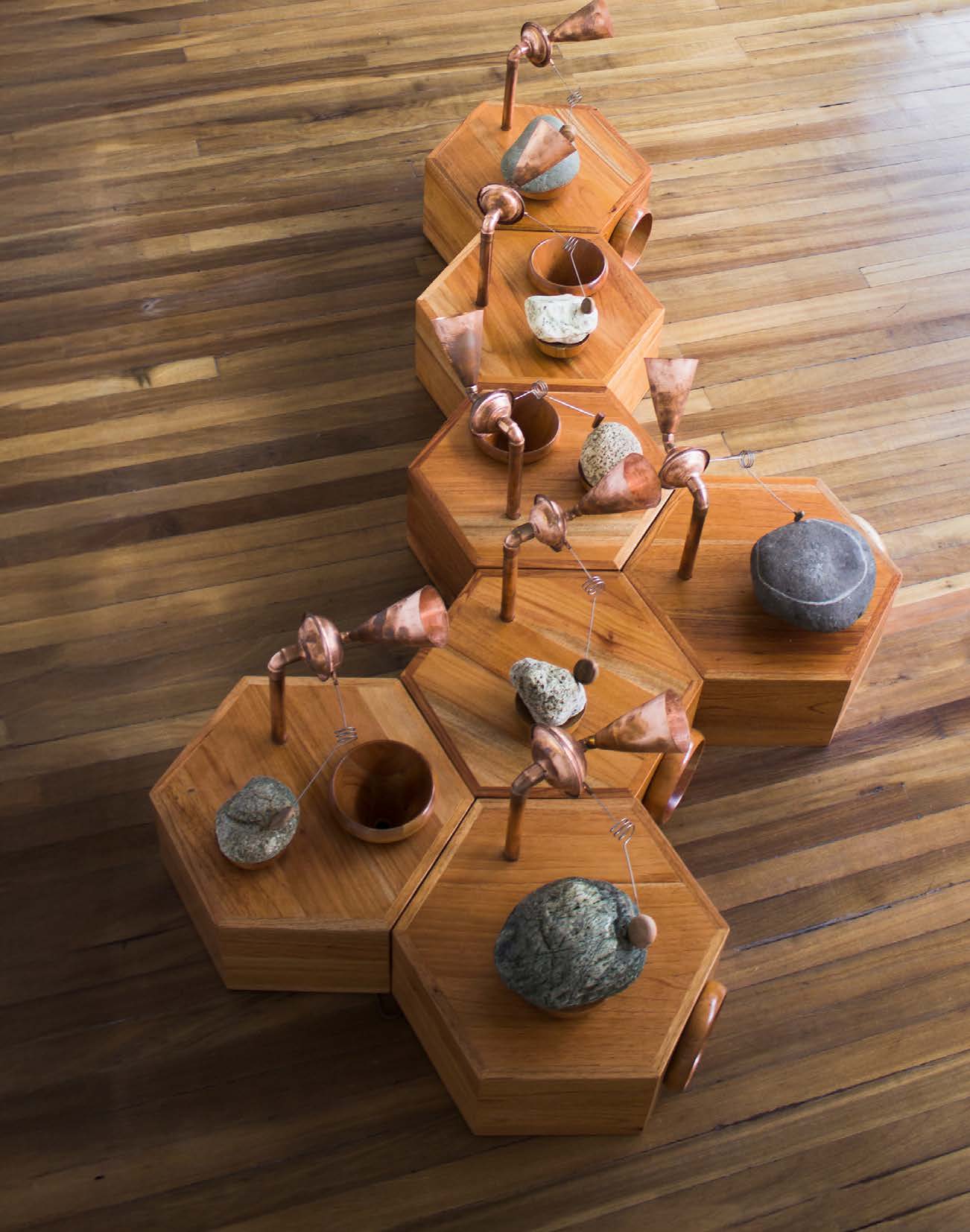
Rock gathered from an anthropogenically intervened or dried river or waterscape in Colombia, wooden needle, resonant membranes, brass bugles, resonance box, electric motor. Seven individual sculptures arranged in a septet.
17.7 x 17.7 x 17.7 in. (45.0 x 45.0 x 45.0 cm)
Collection of the Akron Art Museum
Purchased using finds from the Museum Acquisition Fund
2025.27
Copyright of the artist
More Information
“…listening is above all a political act…Sound, as a subtle, transparent substance without form, yet a vibrational and ductile force, has allowed me to shape the experience of the body and space within a flow of temporal and affective intensities. In my artistic work, I seek to dedicate time to listening, to feeling the sounds and their interpellations, while I stubbornly investigate ways to engage the body in the act of listening, to make the bones resonate, to make the sounds that are around us pass through the heart once again.” — Leonel Vásquez. Canto Rodado is a septet of sculptures that function individually and cohere as a group. Each sculpture is comprised of a wooden hexagon as a base and a spinning wooden turntable, upon which sits a large rock. The rock is slowly rotated, and a metal arm with a wooden circle at the end touches the rock. This wooden circle acts like a record needle, “tracing” the grooves in the rock the way a needle runs over a record and converts the individual grooves in a vinyl disc into sound waves. Each hexagon also includes resonant circles and brass bugles to amplify the sound for a listener. Each rock makes a unique sound, and when combined the seven different sounds make a chorus. This installation is thus both a kinetic sculpture (as the rocks are constantly rotating) and a sound sculpture. As noted in the medium description for this piece, each rock is “gathered from an anthropogenically intervened or dried river or waterscape in Colombia.” Anthropogenic intervention refers to the influence of human beings on nature, and Vásquez is specifically interested in Colombia’s rivers, which find their source in the Andes mountains and slowly make their way down into cities like Bogotá, picking up pollutants like cadmium, lead, heavy metals, and human waste. Many rivers have been diverted for one of Columbia’s major exports, illegal gold mining, leaving dry riverbeds and stones that the artist then harvests. Vásquez explains that he has conducted field research into the hydrogeological scientific interest in water dynamics, geological, sedimentary, and erosion formations, as well as anthropic impacts on the landscape, as well as artistic investigation into exploring the ways of being, doing and talking about the rivers through displaying the river rocks. A description of this series provided by the artist’s gallery, Casa Hoffmann, clarifies the multiple layers of meaning of this body of work: For many communities, rocks are their grandmothers, as they preserve in their hard silences the wise voice of times past. For several years, Leonel Vásquez has been listening to the unique calm and soothing voice of the rocks, of beings who have lived life and view time with perspective, without haste. These are voices that do not seek complex narrative developments, but rather the gentleness and forcefulness of the elemental, which is expressed in their sound. Vásquez produces analog instruments that allow us to see beyond the material substance: he invites us into a realm of bygone days of harmony. The voices of these geophonic beings purify our own waters: by spinning the rock on its own axis and amplifying its sounds, millions of years of geological actions release the creative vibrations of a universal harmonic mineral composition. Music softens the rock, and as the rock rotates, it wears down. This is the same as what the river has been doing before we emerged into this world: a rolling song. Note that “canto rodado” literally translates from Spanish as “boulder,” but the individual words “canto” (song or singing) and “rodado” (rotating or turning about on an axis) together connote a rotating song, as the artist has made here.5These works could be installed over a single power outlet with a timer (which the gallery is happy to coordinate and provide) and could be on long-term display. The brass is the only element of the work which will need infrequent conservation, with slight scouring using pads that the gallery can provide helping to avoid oxidation. The configuration that is pictured is most likely how the septet will be installed, but the artist has indicated that AAM would have the freedom to pursue different configurations that best fit the space.