
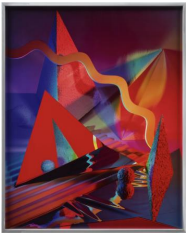
Barbara Kasten
(Chicago, Illinois, 1936 - )
Metaphase 5
From the series "Constructs"
1986
Cibachrome
37 x 29 1/4 in. (94.0 x 74.4 cm)
Collection of the Akron Art Museum
Knight Purchase Fund for Photographic Media
2025.30.1
More Information
Metaphase 5 is part of Kasten’s most well-known series, “Constructs,” created from the late 1970s through the early 2000s. The bold color schemes of Metaphase 5 —reds, blues, purples, and oranges in one; purples, blues, greens, and yellows in the other—create an immediate visual impact. Kasten then sustains viewer interest through mirrors, mylar, and shadows that compress flat shapes and unfold them into dimensional complexity. These works use familiar materials from the hardware store as life-sized props staged within her studio and photographed with mirrors and gelled lighting to create optical confusion. Her staged compositions are indebted to Constructivist experimentation with photography, particularly the work of László Moholy-Nagy, which emphasized geometric abstraction, industrial materials, and construction and assembly over traditional photographic composition. Yet Kasten departs from Constructivism's utilitarian ethos by embracing a distinctly postmodern sensibility—employing intensely saturated colors produced through large-scale Polaroid and Cibachrome prints that emphasize material gloss, surface pleasure, and decorative appeal over functional purpose. This postmodern approach was equally inspired by contemporary architecture and design, particularly the work of Michael Graves and Frank Gehry. Even as Kasten's works have been described as a "hairline away from kitsch," they were perfectly in sync with the exaggerated surfaces and bricolage of buildings by Gehry and Graves. Neoclassical columns and glass bricks, molded archways and curvy latticework, corrugated plastic and cornices, ornate pedestals—all espouse the theatrical and verge on the baroque. These elements are disrupted in her photographs through evidence of the artist's hand, such as the textured surfaces of the spherical forms, gesturing toward the dualisms central to her work: handmade and mechanical, object and image, craft and commodity, modernism and postmodernism. The “Constructs” series established Kasten's distinctive visual language and methodology—combining sculptural installation, optical experimentation, and bold color—that would inform her practice across multiple mediums for decades to come.