
Melissa Joseph
(St. Mary's, Pennsylvania, 1980 - )
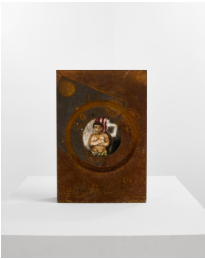
Abs of Steel
2023
Needle felted wool in found steel
12 1/2 x 8 1/2 x 2 3/4 in. (31.8 x 21.6 x 7.1 cm)
Collection of the Akron Art Museum
Gift of Charles Moffett and Melissa Joseph
2026.2
More Information
At the core of Melissa Joseph’s practice is an act of caretaking and bearing witness. Drawing primarily from personal and family photography—archival images of her father as a young man, of her grandparents, and of the quiet rhythms of her bicultural household—she works as a selfdescribed conduit for stories that might otherwise be lost. Her father, a surgeon who immigrated from Kerala, focused his life on survival rather than reflection; Joseph has taken up the work of archiving and honoring his experience, and that of her broader family, on his behalf. Increasingly, she also draws from photographs she takes herself, expanding the archive to include the present and emphasizing “quiet moments regarding the human condition,” as she has described them. The result is a body of work that moves fluidly between the intensely personal and the broadly universal—work that viewers consistently describe as evoking their own families, their own memories, their own sense of belonging and dislocation. Joseph’s practice is also shaped by a sustained engagement with feminist art history and the politics of making. Needle felting is a technique long associated with domestic craft and feminine labor—categories that the art world has historically dismissed. By applying the technique with rigorous precision and deep conceptual intentionality, Joseph insists on its place within the canon of contemporary art while honoring the tradition of women’s material labor it carries. “I’m very interested in feminist conversations,” she has said, “and I think it also aligns with everything I want to do as an artist.” Joseph builds her images from American wool that she works into a backing of industrial felt—a material made from shredded, reclaimed fabric that she selects specifically for its resonance with her interest in found objects and material memory. The process of needle felting requires thousands of repetitive, meditative jabs with a sharp, barbed needle to compress and bind wool fibers into precise, painterly marks. Joseph has described it as a combination of painting and sculpture: viewers often mistake her finished works for paintings until they approach and register the unexpected tactility of the surface. “People will look at my work and think it’s a painting,” she has explained, “then they get up close and realize it’s not. But, to me, it’s not NOT a painting.” She uses a painter’s language, referencing art-historical works, thinking about form and composition—while simultaneously pushing against the boundaries of what painting can be. A growing and significant dimension of Joseph’s practice involves embedding her felted works within found objects: vintage furniture, rubber tires, rusted chains, industrial steel. These objects are not neutral containers; they are chosen because they carry histories in and on their surfaces—traces of labor, use, and regional identity. Joseph, who grew up in a rural factory town and describes herself as having always “collected heavy metal rusted things,” finds these objects grounded in a literal and psychological sense. They also function as a form of material code-switching—a concept central to her thinking about biracial and bicultural identity—reconfiguring how a soft, intimate image is received when housed within an industrial frame. Abs of Steel is a small-scale work measuring 12 inches tall: a needle-felted composition embedded within a found steel box. The work exemplifies the productive tensions that animate Joseph’s practice. Felt and steel occupy opposite ends of various material spectrums—soft and hard, warm and cold, domestic and industrial, feminine and masculine—and yet here they are, held in proximity, the delicate wool image enclosed and protected by its rigid industrial surround. The title heightens this dialogue with sly humor: “abs of steel” is a casual way of suggesting physical toughness, an organic body hardened to a metallic state by labor or discipline — the body itself becoming industrial, indistinguishable from the materials it works alongside. Joseph reframes the phrase onto her own medium, proposing that felt — so often underestimated as soft, domestic, minor — possesses its own kind of steel. The thousands of repetitive needle jabs required to build a single composition demand the same endurance the phrase invokes; the soft surface is, in fact, the product of an exhausting physical discipline, a body of work earned rather than given. The intimate scale of the work amplifies its effect. Where Joseph’s large-scale felted pieces command space and invite broad engagement, Abs of Steel operates differently, asking the viewer to lean in, to approach with attention, to discover the labor encoded in the surface at close range. The steel box functions simultaneously as frame, vitrine, and vessel: a found industrial object repurposed to house something tender and personal, in the same way that post-industrial communities themselves hold family histories, immigrant stories, and domestic life within landscapes shaped by heavy industry. The work is characteristic of Joseph’s recent practice of pairing intimate imagery with objects that carry the weight of regional material culture, and it distills its subject matter into a remarkably concentrated form.