
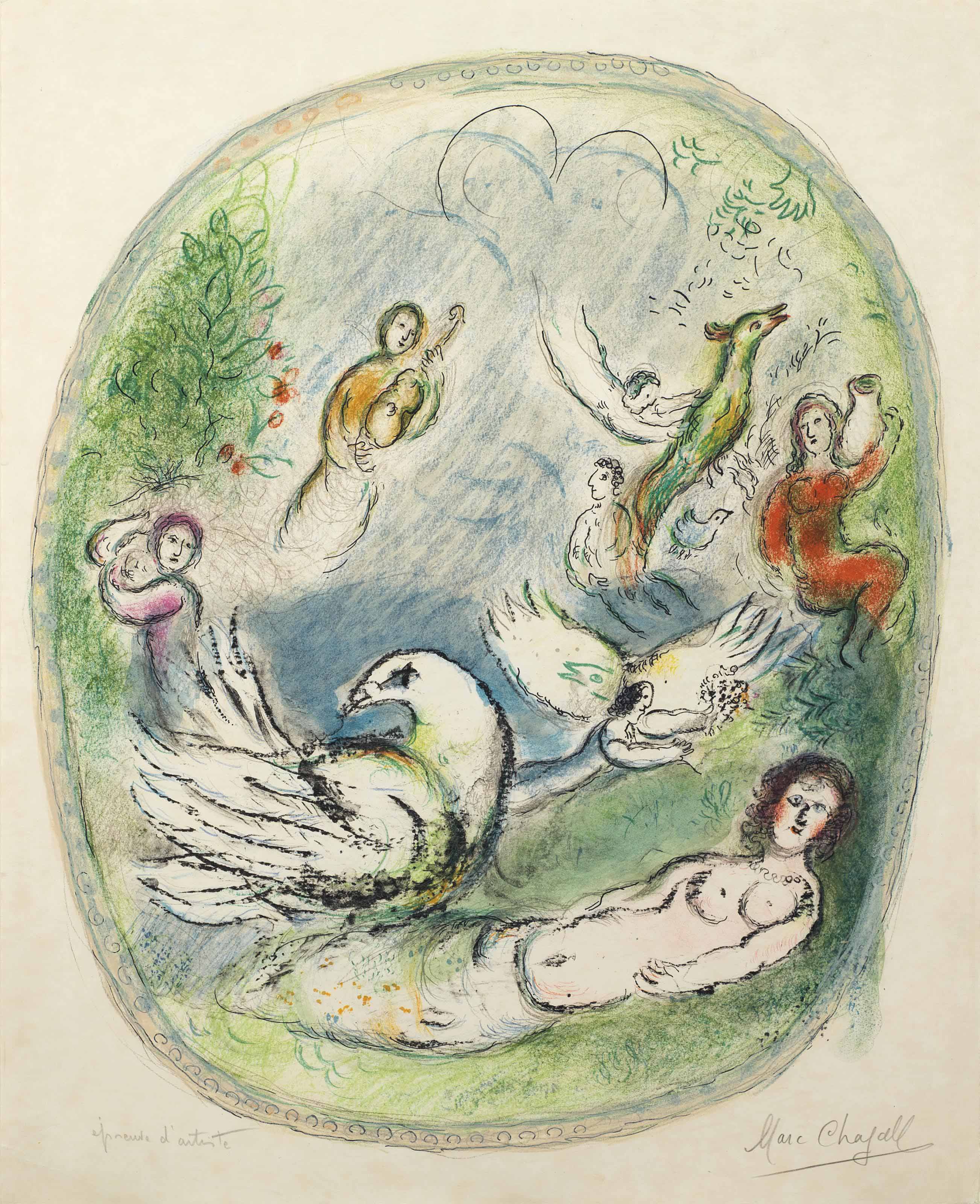
Marc Chagall
(Vitebsk, Russia, 1887 - 1985, St. Paul-de-Vence, France)
L'Age d'Or (The Golden Age)
1968
Color lithograph on Arches paper
55 1/8 x 40 3/16 in. (140.0 x 102.1 cm)
Collection of the Akron Art Museum
Gift of the Clemente children in memory of Dr. Bartholomew Clemente and Anita Lalli Clemente.
2026.7
More Information
Opening his catalogue essay for Marc Chagall’s 1946 retrospective exhibition at the Museum of Modern Art, James Johnson Sweeney noted that Chagall diverged from many vanguard artists of his generation by employing readily recognizable representational imagery of people, animals, landscapes, and more. One might then expect Chagall’s work to support clear narrative or interpretation, but not so. Johnson Sweeney quoted the artist’s response to his own paintings to underscore this point: “I don't understand them at all. They are not literature. They are only pictorial arrangements of images that obsess me… The theories which I would make up to explain myself and those which others elaborate in connection with my work are nonsense… My paintings are my reason for existence, my life and that's all.” So, Chagall’s works are purely pictorial and without important meaning? This is also not the case. Johnson Sweeney turned next to the Surrealist writer André Breton, who observed that it was “with [Chagall] alone, that the metaphor made its triumphant return into modern painting.” Bringing this series of contradictions into a final synthesis, Johnson Sweeney concluded: “This is Chagall's contribution to contemporary art: the reawakening of a poetry of representation, avoiding factual illustration on the one hand, and non-figurative abstractions on the other.” Chagall’s lithograph L’Age d’Or exemplifies this poetic approach to representation. Created in 1968 (in the later stages of the artist’s life, but while he was still engaged in substantial commissions, exhibitions, and other creative work), the print depicts a harmonious coexistence of humans, animals, and nature. None of the figures in the scene have complete lower bodies, and many seem to move about zephyr-like, atop gusts of cloud. They lie in repose, present a bouquet of flowers, hold a vase, and play a violin, suggesting a range of peaceful activities oriented toward beauty and comfort. Birds also adorn the scene, often in close proximity to its human inhabitants and apparently untroubled by their presence. All are surrounded by a lush landscape of green foliage and blue water that—lacking a defined horizon line or clear boundaries between land, water, and sky—suggests an idea of place far more than any specific location. Together, these features aptly suggest the print’s titular “Golden Age” neither factually nor abstractly, but as a dreamlike, poetic notion. The edition of L’Age d’Or under consideration here is part of an edition of fifty created by Chagall in collaboration with Mourlot Editions in Paris. The firm has specialized in lithographic printing since 1852, beginning with commercial work and theater and cabaret posters before moving into art posters and then art prints, working with artists including Pablo Picasso, Henri Matisse, Jean Miró, Georges Braque, Jean Dubuffet, Fernand Léger, and Alberto Giacometti.