
Kelli Connell
(Oklahoma City, Oklahoma, 1974 - )
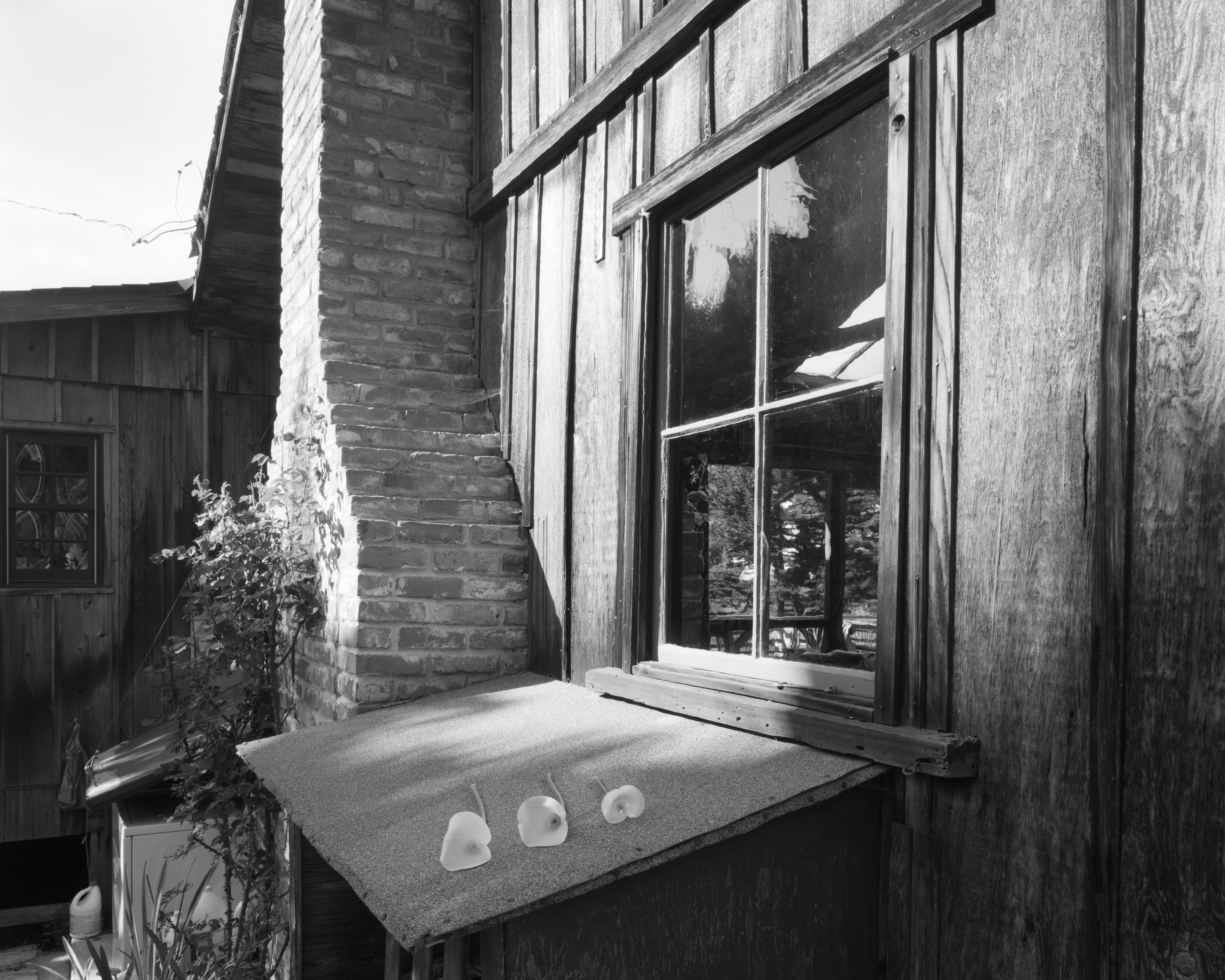
Three Calla Lillies (Springtime)
From the series "Pictures for Charis"
2022
Pigmented inkjet print
40 x 50 in. (101.6 x 127.0 cm)
Collection of the Akron Art Museum
Purchased with funds from the Museum Acquisition Fund
2026.11.4
More Information
In her series “Pictures for Charis,” Kelli Connell draws on the writings of Charis Wilson to reframe the experience of being photographed from the subject's point of view. Wilson's firsthand accounts reveal that she did not experience posing as a passive act; she felt instead that Edward Weston was recording her choreography, her own physical intelligence and intention. She often identified locations, generated ideas for images, and understood the act of posing as a collaborative one. This perspective animates Connell's project and shapes her approach to photographing Betsy Odom across the sites where Wilson and Weston worked together. Connell writes in the narrative of the catalogue, “What did these portraits made of her, along with the ones taken throughout the time they were together, say about their relationship and who Charis was in relation to Edward? I wanted this new work to explore female-to-female dynamic. Perhaps my photographs with Betsy, defined by our intimate relationship, could raise questions about the image and nature of intimacy—of power, agency, and the direction of the gaze. The four works proposed for acquisition span two distinct phases of Connell's engagement with the project. Oasis (2015) and Marfa (2004) were made during the early years of research and travel, when Connell and Odom were retracing the routes of Weston's Guggenheim Fellowship years (1937–1938), the period during which he received his first Guggenheim award and used the funding to make landscape photographs across California and the surrounding states. That journey produced California and the West (1940), with twelve chapters of text by Wilson accompanying Weston's photographs, a structure that Connell mirrors in the exhibition catalogue by weaving her own writing alongside her images. These earlier works carry a quality of closeness, the camera near to the body and at ease with its subject. Oasis is a black-and-white photograph taken from below, looking up through a canopy of palm trees into an open sky, evoking the vast, sun-bleached terrain that Wilson and Weston traversed. Its pair, Marfa, is a color photograph of Odom lying down, eyes closed, her naked torso partially veiled by the shadows cast by window blinds, a composition that recalls Weston's sensuous studies of Wilson while centering Odom's quiet interiority. Window (2022) and Three Calla Lilies (2022) were made at Wildcat Hill, the home Weston and Wilson shared in Carmel Highlands and one of the most charged sites in their shared history. Made nearly two decades after Oasis and Marfa, these later works register a shift in feeling, something cooler and more at remove, the subject less immediately available to the lens. Window pictures Odom from outside, the camera positioned beyond the glass and looking in. Odom, dressed in a black hoodie and orange jacket, meets the lens directly yet registers as remote, her hand caught in the act of pulling back or releasing her hood. The partially visible window frame resists easy orientation, holding Odom in an ambiguous threshold between interior and exterior, private and observed. Three Calla Lilies is a black-and-white exterior view of the Wildcat Hill home, in which three calla lilies emerge in a row from a roofline window, their forms geometric and still. The window may be the same one through which Weston famously photographed Wilson, and Connell's image quietly activates that history without illustration, letting the site speak. Across all four works, time and proximity leave their mark, legible not through statement but through the accumulated evidence of the images themselves.