
Red Grooms
(Nashville, Tennessee, 1937 - )
Katherine, Marcel, and the Bride
1994-1998
130-color screenprint on wood with mirror and patinated copper
44 x 35 1/2 x 5 1/2 in. (111.8 x 90.2 x 14.0 cm)
Collection of the Akron Art Museum
Gift of Mitchell Shaheen
2026.21
More Information
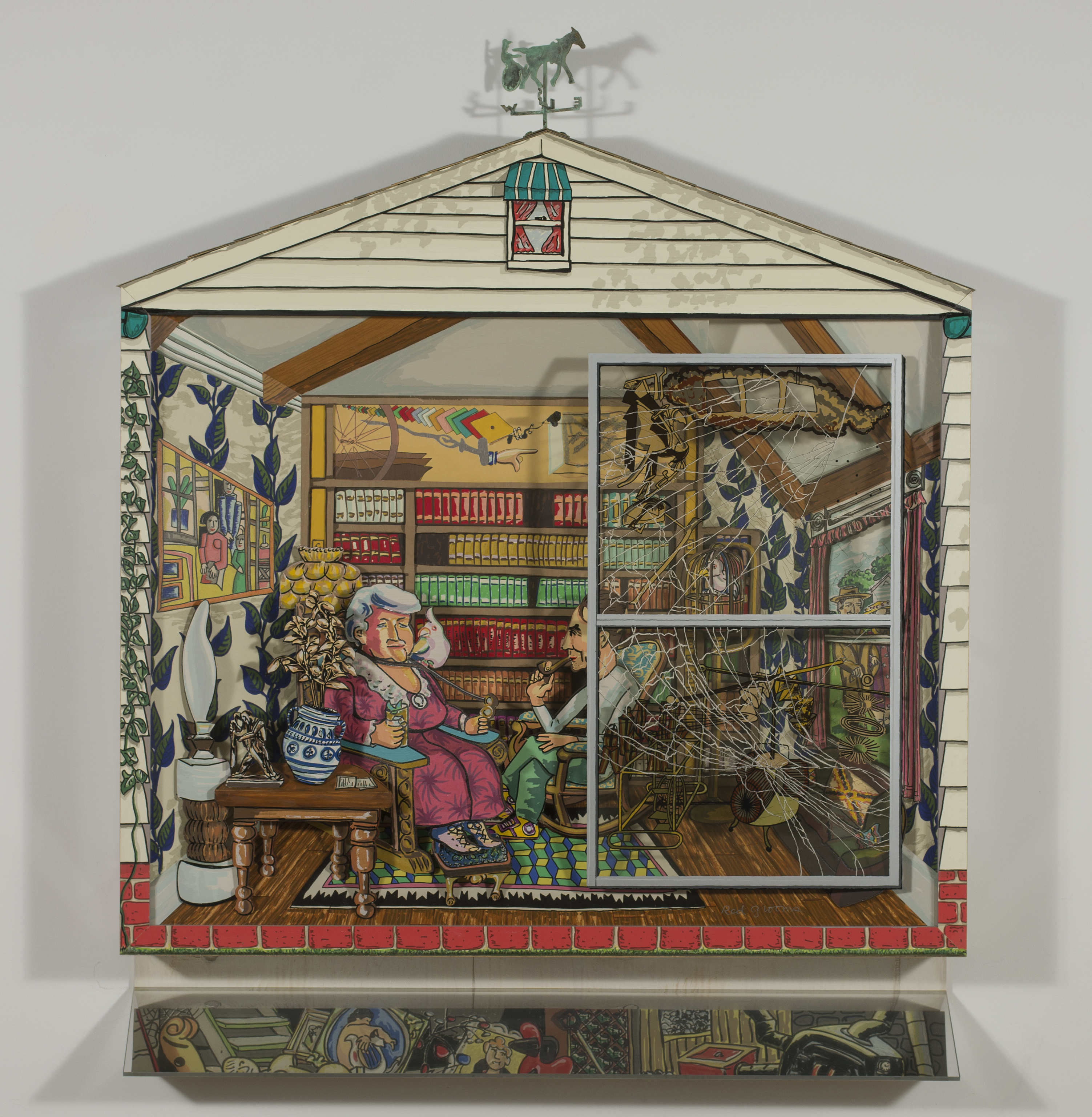
In his printed and assembled multiple Katherine, Marcel, and the Bride, Grooms returned to the composition of his 1984 painting A Room in Connecticut, now in the collection of the Pennsylvania Academy of Fine Arts. That institution’s description of the painting equally fits its later adaptation as an edition: "A Room in Connecticut belongs to Grooms's continuing series of "art about artists." This fanciful tribute to the American avant-garde depicts the artist Marcel Duchamp and his patron the collector Katherine S. Dreier—two of the founders of the Societe Anonyme, established in 1920 to promote American and European modernism—conversing in the art-filled library of Dreier's West Redding, Connecticut, home. Two works by Duchamp are recreated by Grooms: above the bookcase, the painting Tu m' (Yale University Art Gallery), and at right, a three-dimensional rendering in Plexiglas and aluminum of The Bride Stripped Bare by Her Bachelors, Even (Philadelphia Museum of Art). As a bonus, Grooms lets us spy another two modernist figures through the window: Baroness Hilla Reby, the first director of the Guggenheim Museum, and the architect of the Guggenheim's building, Frank Lloyd Wright." - A Room in Connecticut, 1984 Brett Shaheen, the source of this donation, provides this additional information on Grooms’s conversion of A Room in Connecticut into Katherine, Marcel, and the Bride: "The original planned edition size for this piece was 48, but the project took on a life of its own so-to-speak (in terms of visual and material complexity), it became too costly, and I don't know if the entire edition was ever completed. Katherine, Marcel and the Bride is the most visually and materially ambitious and sophisticated 3-D multiple that Grooms has produced and, by the artist’s own account, his best. Whereas most of Grooms’s multiples are printed on museum board (or some comparable variety of heavy-weight paper), this piece is printed on and entirely constructed of wood; each shingle on the roof is individually laid, and the weathervane is patinated copper. The image depicts Duchamp sitting in the study of one of his patrons, the eccentric early 20th century collector Katherine Dreier. The pair is surrounded by some of the artist’s great masterpieces—including The Bride Stripped Bare by Her Bachelors Even, a.k.a. The Large Glass, which is screened onto the plexi and anchors the right-hand side of the composition—as well as works by other modernist masters. The basement is screen-printed onto the underside of the house and reflected in the mirror at the bottom of the piece (because, purportedly, Dreier had heaps of modernist masterpieces just sitting around in her basement)." While it is an editioned work, Katherine, Marcel, and the Bride is thus unique and impressive for a work produced in multiple. Its intricacy of construction and its shallow but effectively convincing three-dimensional space, as well as its added elements depicting the roof and basement, make it a rare instance where a derived edition might surpass an original painting in creativity and appeal. It is also fitting that Grooms depicted Duchamp and examples of his work in a multiple, as the earlier artist was himself a prolific producer of multiples, especially with his various “readymades.” Duchamp’s artworks often exist as much (or more) as ideas than as physical objects, not only making multiples appropriate, but making translations of his work into additional media particularly apt—Duchamp pursued this very course with his various boxed collections of miniature reproductions, which have been described as portable museums representing his career. Grooms’s effort to likewise present Duchamp, some of his greatest hits, and the ambiance of his artistic circle thus seems not only like the telling of art history, but the continuation of the creativity of a fellow irreverent and groundbreaking artist. Indeed, Katherine, Marcel, and the Bride brings out areas of commonality between Grooms and Duchamp—both were glad to build environments that surrounded viewers in strangeness, Grooms through caricatures and exaggerations of American life, Duchamp through a similar view of modernity and artmaking itself. Katherine, Marcel, and the Bride effectively combines these strains by presenting the New England home of a wealthy and connected art collector, filled to the brim with objects that even devotees of avant garde art would have to agree are somewhat bizarre and often far from conventional characteristics of beauty. The result is a colorful, energetic, and positive view of the appeal of modern art through its compelling oddity.