
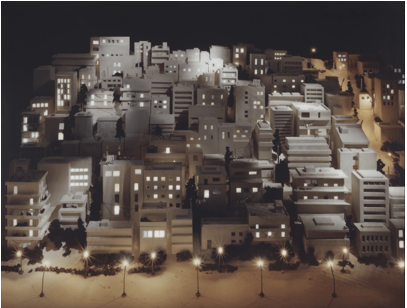
James Casebere
(Lansing, Michigan, 1953 - )
Tripoli
2007
C-print mounted on Dibond
23 x 30 in. (58.4 x 76.2 cm)
Collection of the Akron Art Museum
Gift of Susan Jacobson in honor of Steven Jacobson
2025.9
© James Casebere
More Information
This photograph debuted in The Levant, a solo exhibition at Sean Kelly Gallery in 2007. Casebere’s work in the exhibition was inspired by both secular and religious architecture from the geographical area of the Levant, in the Middle East. The word “levant” comes from the French “lever,” meaning to rise, and is equivalent to the Arabic “Mashrik,” meaning the country where the sun rises. The Levant is the region on the eastern end of the Mediterranean Sea, particularly Lebanon and Syria, but also Greece, Turkey, and Egypt. The project started with a trip to southern Spain in 2004 where Casebere immersed himself in Moorish architecture. Subsequently, the artist traveled to Turkey where, in preparation for his participation in the 2006 Seville Biennial curated by Okwui Enwezor, he researched Ottoman architecture, particularly that of Sinan (1489–1588), generally considered the greatest of all Ottoman architects. From Rustem Pasha Mosque and the dormitory at Topkapi Palace in Istanbul, to the al-Askari Mosque in the Iraqi city of Samarra (known as “the golden mosque”), to Tripoli in Lebanon, and to Egyptian domestic interiors, Casebere continued his investigation of architectural spaces in these images, while revealing complex past and present historical legacies and traditions For Tripoli, as he has done for numerous other photographs, Casebere constructed a complex model that he subsequently photographed in his studio. His table-size constructions—based on architectural, art historical, and cinematic sources—are made of simple materials, pared down to essential forms, and frequently emptied of extraneous detail. His subject matter has focused on institutional spaces and the relationships between social control, societal structure, and ever more sophisticated levels of interpretation. There are two cities named Tripoli, and this photograph is based on the city in Lebanon, which the artist visited in person. Tripoli is an important seaport on the Mediterranean, and the second largest city in the country, with a rich history dating back thousands of years.