

Alice Pixley Young: Half Life
The Judith Bear Isroff Gallery
August 8, 2026 – January 31, 2027
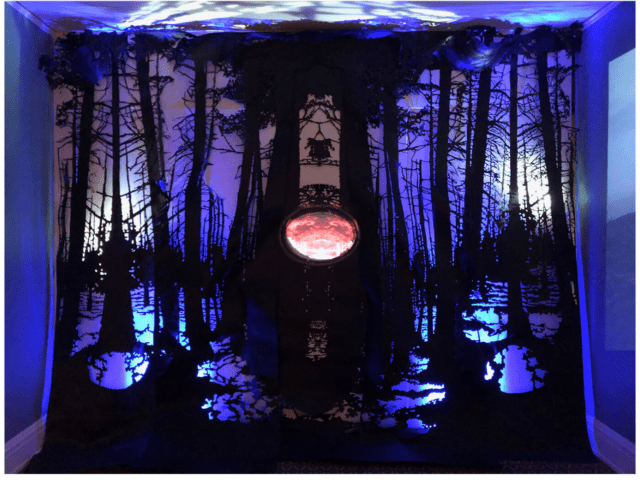
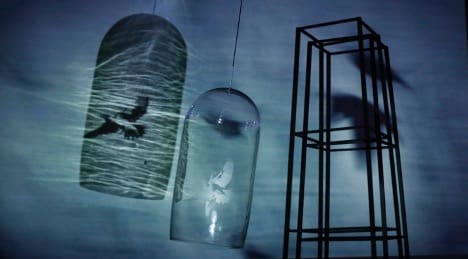
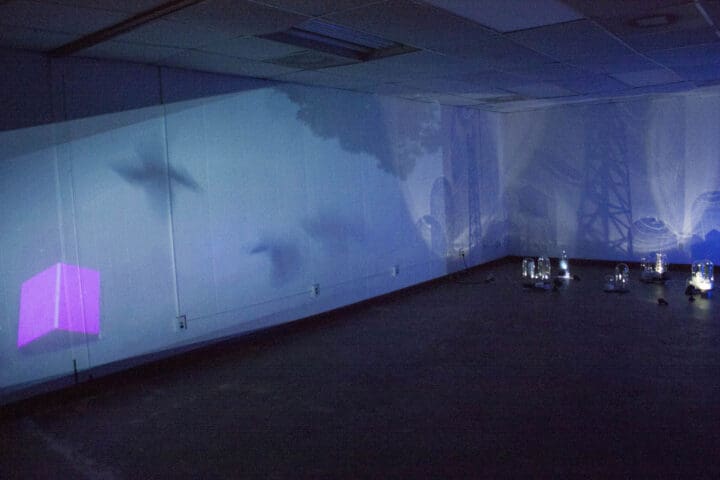
Cincinnati-based artist Alice Pixley Young draws inspiration from many sources, including formal gardens, geology, deep time, resource extraction, the nuclear age, and the ecological history of Ohio. Young’s installation at the Akron Art Museum forms an immersive environment featuring new works in video, glass, paper, and light. Her layered landscapes dramatize the entanglements of time, land, geology, and biodiversity. Visitors are invited to use this space to step outside their normal routines and think about time on a variety of scales. Young engages with several different time spans. The Ordovician fossil beds in southern Ohio contain numerous fossils of invertebrates that lived in a shallow tropical ocean 450 million years ago. Today, visitors to the region can easily find these fossils in riverbeds.
In the recent past, from 1951 to 1989, the Fernald Feed Materials Production Center located 20 miles northwest of Cincinnati refined uranium for use in nuclear weapons for the federal government. Millions of pounds of uranium dust were released into the air during the site’s operation, and nuclear waste—slightly enriched and depleted uranium, thorium, radium, and other radioactive materials—contaminated the soil, groundwater, and surface water of the surrounding area and the Great Miami Aquifer. The facility was listed as a Superfund site by the Ohio and U.S. Environmental Protection Agencies. Remediation concluded in 2007 when the site was renamed the Fernald Preserve and transformed with man-made wetlands and greenery. Nevertheless, it remains unfit for human habitation.
The prolonged contamination of the Fernald Preserve can be grasped through the term “half-life,” a concept used in nuclear physics to describe how quickly unstable atoms undergo radioactive decay. The half-life of enriched uranium used in nuclear weapons is 700 million years, meaning that the material will diminish by half over that period. It will take many more millions of years in the future until that material is sufficiently decayed to pose no harm to living creatures.
The phrase “half life” could also be a framework for thinking about objects and systems that are partly “natural” and partly human-made, or partly alive and partly dead. A planned landscape may contain many different kinds of plant life, but whether it is a small garden or a large remediation project, it is still carefully cultivated, and thus different from a forest. A fossil, which was once part of a living plant or animal, has been transformed over millions of years into a geological specimen and, while no longer alive, can still retain much of the physical form of a living being.
Alice Pixley Young (b. Washington, DC) has created recent multimedia installations for Crystal Bridges Museum of American Art, the Taft Museum of Art and Sarasota Art Museum. Additionally, her work has been exhibited nationally and internationally including the Print Studio London, ArtPrize/UICA, and recent solo shows at the University of Kentucky’s Bolivar Gallery, and the University of Rochester’s Hartnett Gallery. Her work is in several public and private collections including the 21c Museum/Laura Lee Brown and Steve Wilson. She is the recipient of grants from the Puffin Foundation, Ohio Arts Council and was named an Ohio ‘Women to Watch’ by the National Museum of Women in the Arts. Her work can be seen in Sculpture Magazine, Hyperallergic, Artnet News and the Midwest 2026 New American Painting issue. She recently completed residencies at Kala Art Institute in Berkeley, CA and Two Coats of Paint in Long Island City, NY. Young is an alumni member of A.I.R. Gallery in Brooklyn with a solo exhibition opening there in February 2026. Her studio is located on the Ordovician fossil bed, the Myaamia homelands, near to a nuclear superfund site in the region colloquially termed the Rust Belt (Cincinnati, Ohio).